
A Zestek steering wheel conversion can make a performance car feel more focused from the moment you take hold of it. The appeal is obvious: a compact wheel, magnetic paddles, configurable controls and a proper quick-release system. The buying decision is less obvious, because the wheel rim, SCX control panel, boss kit and vehicle electronics all do different jobs.
This Zestek steering wheel fitment guide explains how the system fits together, which version suits an OEM-based road or track car, what changes for a standalone ECU build, and the checks worth making before you order. It is not a substitute for a vehicle-specific fitment check. Steering, airbag and control-system work is safety-critical, so the exact model, year, ECU arrangement and intended use all matter.
What is a Zestek steering wheel system?
It helps to stop thinking of it as one product. A complete installation is normally assembled from several parts:
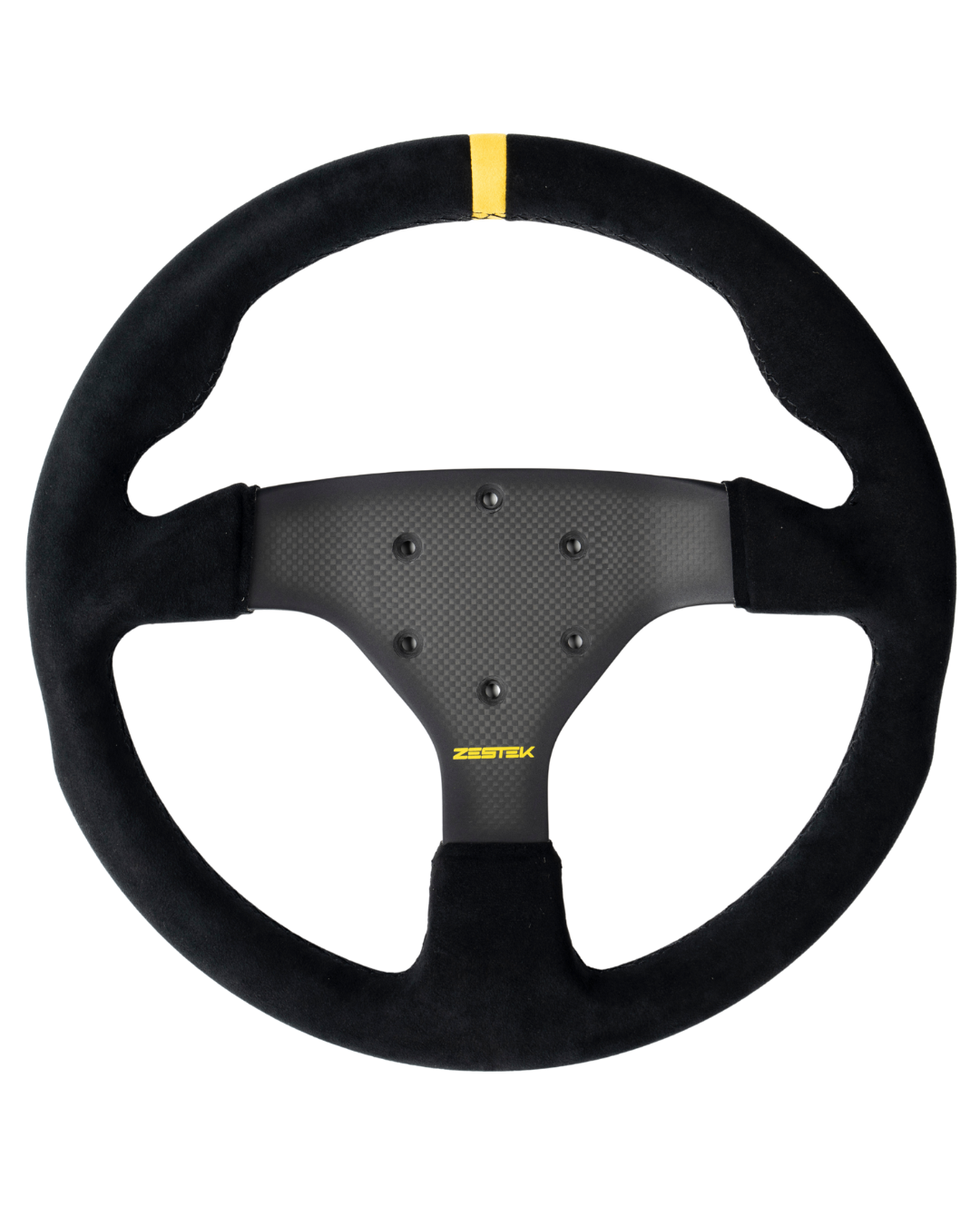
- Steering wheel rim: the part you hold, such as the Zestek Racing carbon-fibre 330mm steering wheel.
- Control panel or hub: the electronics, buttons, rotary controls, paddles and lighting. For many factory-ECU cars, this is the Zestek SCX.
- Quick release: the mechanical and electrical connection that allows the wheel assembly to be removed.
- Vehicle-specific boss kit: the adaptor that connects the system to the steering column. It must match the exact application.
- Communication hardware: the vehicle-specific interface, OBD module or custom CAN wiring needed for the chosen control system.
Buying only a wheel rim does not give you a complete SCX conversion. Equally, an SCX control panel does not automatically include the correct boss kit or an aftermarket rim. Always read the individual listing and selected variant rather than assuming every component is bundled.
Zestek SCX or a standalone CAN hub?
This is the most important decision in the process. The correct answer depends on the electronics in the car, not simply the make or model printed on the bonnet.
SCX for supported cars using the factory ECU
The SCX is designed around supported vehicles that retain their original equipment manufacturer ECU. Its purpose is to provide a race-style driver interface while keeping supported factory steering-wheel functions through Zestek's vehicle-specific communication system.
Depending on the application, this can include functions originally available on the factory wheel, plus programmable lighting and expansion through Zestek's VeloLink ecosystem. Zestek states that the SCX works with most 330mm and 350mm aftermarket steering wheels using a 6x70mm bolt pattern, although clearance still needs checking. The manufacturer's official SCX overview and user guide cover Workstation software, button mapping, lighting configuration and vehicle-specific installation procedures.

Nineteen72 lists vehicle-specific SCX options for selected BMW, Audi, Volkswagen, Porsche, Toyota, MINI and SEAT applications. For example, the Zestek SCX control panel for supported BMW G-series cars is a different listing from the BMW F-series, Porsche or Golf versions. Similar-looking products are not evidence of interchangeable fitment.
Standalone ECU and custom CAN installations
A race car running a standalone ECU, PDM or custom CAN network needs a different approach. In this case, functions are defined by the vehicle's wiring, ECU or PDM configuration, selected modules and the person programming the system. The Zestek CANBus racing steering wheel hub for standalone ECUs and PDMs is intended for that type of advanced installation.
Do not buy a factory-ECU SCX on the assumption that an installer can make it work with any standalone system. Likewise, do not choose a custom CAN solution for a standard road car unless there is a clear integration plan. For a mixed build that needs both supported OEM controls and custom CAN devices, confirm the appropriate current Zestek product and wiring specification before ordering.
What does the 330mm Zestek wheel change?
A smaller wheel can make steering inputs feel quicker because your hands travel a shorter distance for the same steering angle. It can also improve clearance in a car with a fixed bucket seat or roll cage. That does not mean smaller is always better.
The 330mm Zestek wheel uses a compact carbon-fibre structure with an Alcantara grip and a centre marker. Its low mass and modest diameter suit a focused cockpit, but the complete conversion should still be judged as a system. Check sightlines to the instrument display, knee clearance, paddle reach and whether the rim obscures warning lights. In a road car, also consider low-speed leverage and how comfortable the grip remains during longer journeys.
The live Nineteen72 listing specifies a 6x70mm interface and notes that a compatible hub, boss kit and quick release are required unless supplied as part of another package. That distinction is important: the rim can be used with a full Zestek control-panel installation or as part of a simpler motorsport setup, but the surrounding hardware determines whether the finished system works safely.
Boss kits, quick releases and the parts people miss
The boss kit is the mechanical link between the steering column and the aftermarket system. It is not a universal spacer. Even where one boss kit is marketed for a family of vehicles, the exact steering-column design, clockspring arrangement and electronics must be checked.

Before ordering, establish whether the selected package includes each of the following:
- the control panel or hub;
- magnetic paddle shifters, if required;
- the quick-release assembly;
- the correct boss kit;
- an aftermarket steering wheel rim;
- the vehicle communication module or wiring loom;
- spacers and installation hardware.
If one element is missing, the rest of the package may be unusable until the correct part arrives. Browse the full Zestek steering wheel and control range, then contact Nineteen72 with the car's exact model, year, transmission, current ECU setup and intended wheel before committing.
Will the factory buttons, paddles and lights still work?
On a supported OEM-ECU application, the SCX is designed to retain supported factory steering-wheel functions through its vehicle-specific interface. That wording matters. The available functions depend on the application and configuration, and an aftermarket panel should not be assumed to reproduce every feature on every original wheel.
Zestek's Workstation software is used for supported configuration tasks such as button mapping and lighting setup. Expansion modules can add further functions, but they are not a shortcut around compatibility. If a control is important, such as cruise control, drive-mode selection, exhaust-valve control or a specific dashboard function, confirm that exact requirement before ordering.
Road-car safety and legality
Replacing a factory steering wheel commonly changes or removes the original airbag arrangement. It can also affect the horn, clockspring, warning lights, insurance position and road legality. A removable motorsport wheel may be entirely appropriate for a dedicated track car, but that does not automatically make the same conversion suitable for a road car.
Professional installation is strongly recommended. The steering fastener, boss, quick release and electrical connections must all be correct, and any warning or safety-system implications need to be understood before the vehicle is driven. Tell your insurer about material modifications and confirm the requirements that apply to the vehicle's use.
Which Zestek setup should you choose?
Fast road and occasional track use
For a supported car that retains its factory ECU, start with the vehicle-specific SCX listing and a suitable 330mm or 350mm rim. Prioritise retained functions, comfortable reach and clear instrumentation over the most aggressive-looking configuration.
Dedicated track car with the factory ECU
The SCX can still be the logical route if the vehicle remains on a supported OEM ECU. A compact rim, magnetic paddles and quick release can improve access and put key controls within reach. Confirm that the final layout suits gloves, seating position and any cage or door-bar constraints.
Race car with standalone electronics
Choose the standalone or custom CAN route and involve the electronics installer before placing the order. Button assignments, paddle inputs, lighting and auxiliary controls should be planned with the ECU, PDM and wiring loom as one system.
Zestek steering wheel FAQ
Does a Zestek SCX include the steering wheel?
Not necessarily. The SCX control-panel package and the steering wheel rim are separate unless the chosen listing or variant explicitly says otherwise.
Do I need a boss kit?
Yes, a compatible vehicle-specific mounting solution is required. Match it to the exact car and Zestek system rather than choosing by bolt pattern alone.
Can I use a 330mm aftermarket wheel?
Zestek states that the SCX supports most 330mm and 350mm wheels with a 6x70mm PCD, but 330mm clearance can be tight. Confirm the particular rim, spacer and control-panel combination.
Will SCX work with a standalone ECU?
The standard SCX is intended for supported vehicles retaining the OEM ECU. Standalone ECU and PDM builds require the appropriate CAN-capable solution and custom integration.
Can I fit a Zestek steering wheel myself?
Zestek provides installation and software guides, but steering-wheel removal, airbag systems, critical fasteners and vehicle electronics carry real risks. Professional installation is the sensible choice unless you have the relevant experience and information for the exact application.
If you are unsure which combination is right, send Nineteen72 the vehicle details and a short outline of the build. The team can help identify the relevant live product listing and the fitment questions that need resolving before purchase.